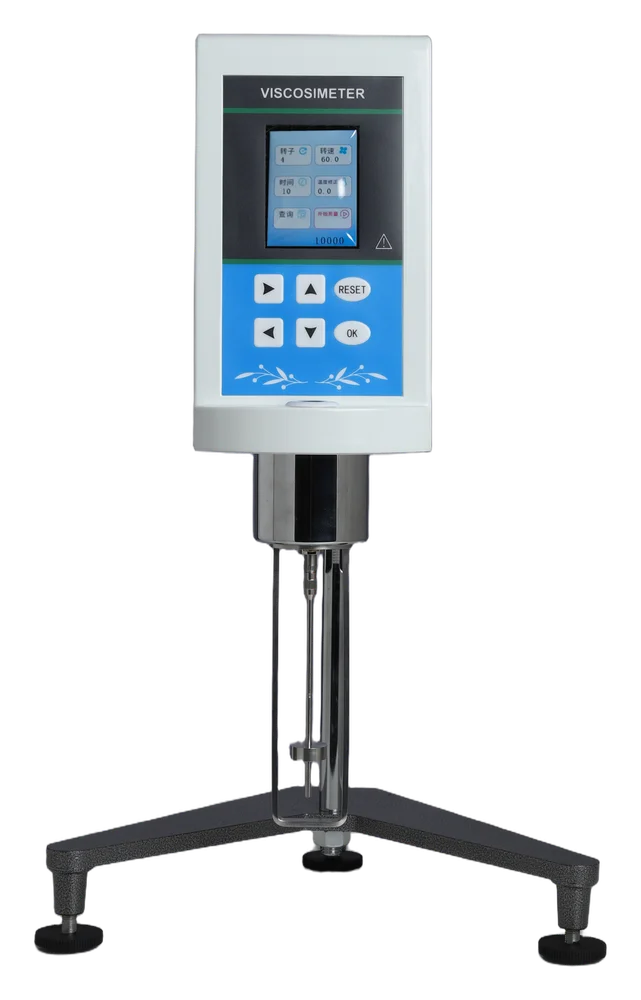
SNB-1
Digital Rotational Viscometer
A color-display model with four selectable speeds and Nos. 1–4 spindles for routine laboratory viscosity checks.

Viscosity basics
Use a worked example to distinguish full-scale accuracy from percent-of-reading accuracy and ask better questions about your working range.
An accuracy figure needs its basis. “±2% of full scale” and “±2% of reading” are different statements. Comparing the percentages without that distinction can lead to an unsuitable instrument or an unrealistic acceptance limit.
Brookfield's calibration guidance uses the full-scale range of the spindle/speed setup when calculating its stated instrument contribution, and treats the reference-fluid contribution separately. Its numerical specifications apply to its own equipment; the example below is an independent illustration of the arithmetic. [1]
Assume a hypothetical setup with a 10,000 mPa·s full scale and a specification of ±2% of full scale:
The ±200 mPa·s amount stays the same in this example because the assumed full scale stays the same. Its size relative to the reading changes. These values illustrate the definition; they do not identify a tested spindle/speed configuration or predict the complete uncertainty of a real measurement.
The current SNB-1, SNB-2 and SNB-3 listings state accuracy of ±2% of full scale and repeatability of ±1% of full scale. They also retain the condition to confirm the applicable procedure and configuration.
For an inquiry, provide your expected working values and any allowable measurement error. Ask which spindle/speed combination is proposed and what full-scale value applies there. Do not insert the model's largest catalog viscosity into a worksheet unless it is actually the full scale of the selected setup.
A reference-fluid check is useful only when its conditions and acceptance rule are specified. Read the fluid's certificate and the instrument procedure together; the instrument term is not the only consideration in interpreting the check. [1]
Our suggested record includes the fluid identity and certificate, certified value and temperature, instrument ID, configuration, observed conditions and result. Keep the arithmetic used for the acceptance decision with that record. If your organization requires a formal uncertainty evaluation or accredited calibration, state that requirement separately when requesting documentation.
Before choosing between models, ask these questions:
Answering these questions gives your purchasing and laboratory teams the same basis for comparison. It also prevents a small headline percentage from being mistaken for a guarantee at every point across a broad catalog range.
No. Calculate the stated percentage of the applicable full-scale value for the selected setup. Its percentage of a smaller reading can be larger than 2%.
No. Establish the applicable full scale for the specific spindle and speed. The largest value across the model's configurations is not necessarily the range in use.
Sources explain measurement principles and methods. Measight configurations are described separately in the linked product pages.
Digital Rotational Viscometer
A color-display model with four selectable speeds and Nos. 1–4 spindles for routine laboratory viscosity checks.
Digital Rotational Viscometer
Eight selectable speeds, including low-speed settings, with a color display and Nos. 1–4 spindles for rotational viscosity testing.
Digital Rotational Viscometer
Nine selectable speeds starting at 0.1 rpm, with a color display and Nos. 1–4 spindles for measurements under defined conditions.